01
Marketplace architecture
Multi-vendor catalogues, vendor onboarding, commission rules and order routing across sellers.

SolutionWeb Challengers
Custom commerce and payment platforms for models standard stores can't express — marketplaces, account-based pricing, subscriptions, split settlement and transaction workflows with reconciliation built in.
Off-the-shelf stores assume one seller, one price list and one simple checkout. The moment your model involves multiple vendors, negotiated account pricing, split settlements or recurring revenue with usage components, templates start bending — and bent templates break at the worst times. That's where custom platforms earn their keep.
We build the commerce engine around your model: pricing rules that reflect how you actually sell, checkout flows that match how customers actually buy, and payment architecture — escrow-style flows, marketplace splits, refunds and chargebacks — designed with your accountant in the room.
Reconciliation is the difference between a platform and a liability. Every transaction state is tracked and matched end to end, so finance closes the books without a spreadsheet marathon — and disputes, refunds and failed settlements have a documented path.
Pricing and checkout built around your real model
Marketplace splits, escrow flows and multi-party payments
Subscriptions and account pricing handled natively
Reconciliation and finance reporting built in from day one
Scoped to your model — each capability below appears only when the model calls for it.
Multi-vendor catalogues, vendor onboarding, commission rules and order routing across sellers.
Account-based pricing, negotiated rates, tiered discounts and quote-to-order flows for B2B models.
Multi-provider payment flows with authorisation, capture, splits, refunds and chargeback handling.
Plans, trials, usage components, proration and dunning — recurring revenue engineered to not leak.
Every transaction tracked to its ledger entry — with reports finance trusts and audits pass.
Orders, payouts, disputes and exceptions visible to your team — with clean hand-offs to back office.
Real project patterns connected to this service, solution or industry experience.
View all case studies
The Laravel and MySQL core of the Suguin ecosystem, managing sellers, retailers, customers, delivery partners, catalogues, orders, content, promotions, approvals, payouts, support and platform-wide controls.
View case study↗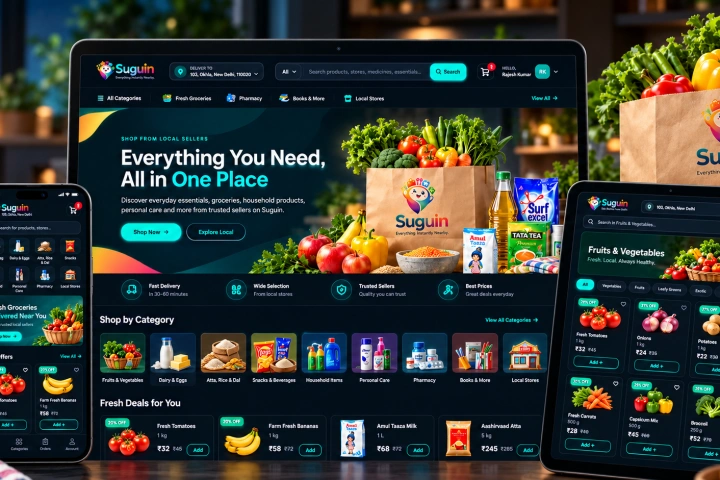
A responsive Vue.js marketplace for local shopping across groceries and everyday products, with search, categories, product detail, cart, checkout, account and order flows connected to the Suguin platform.
View case study↗Commerce platforms succeed when the transaction logic is right — so that's where we start.
Every pricing rule, payment flow and settlement path documented with finance in the room before build.
Pricing, checkout and payment architecture delivered first and tested against real scenarios.
Storefront, vendor portals and admin tooling built on the proven transaction core.
Staged go-live with monitoring — then finance reports checked against reality every cycle.
Draw the full path of a transaction through your model: who pays, who's paid, what's withheld, what's refunded, who's liable when it fails. Platforms built without this map discover their payment architecture during their first dispute — an expensive and avoidable education.
Payment splitting, marketplace guarantees, consumer distance-selling rules and tax handling carry legal obligations that shape architecture. We flag these early and build with them — because retrofitting compliance after launch is the most expensive kind of construction there is.
Straight answers about how this work is scoped, delivered and supported.
Ask something else →Yes — vendor onboarding, commission rules, split payouts and dispute handling are core to this solution, built on providers like Stripe Connect where appropriate.
That's a common trigger for custom builds — negotiated pricing, credit terms, quote-to-order and purchase-order flows all work natively here.
When the model outgrows it, yes. We migrate catalogue, customers and order history, and keep Shopify running until the new platform proves out on real traffic.
As first-class workflows, not exceptions — retry schedules, customer communication, dispute evidence and the ledger entries that keep the books true.
Describe how money actually moves through your business. We will show you what a platform built for that model looks like — costs included.
Discuss your platform ↗