
01PHASE 01
Understand the operation
Map the business goal, users, workflows, existing tools, data, constraints and what success needs to look like in practice.
A shared understanding

We bring 18+ years of hands-on development experience into planning, architecture, delivery and support — so the work is not only built well, but scoped intelligently, operated efficiently and easier to evolve later.
A large part of good delivery happens before the first production feature is written. We look at the business model, users, current systems, team capability, integrations, data, hosting, security and the likely life of the product before recommending a route.
Because we have worked across websites, SaaS products, marketplaces, mobile-connected platforms, APIs, eCommerce, WordPress estates, Laravel applications, cloud infrastructure and long-term support, we can often recognise patterns early — including where a simpler option will work better than a larger build.
That means planning is not separate from engineering. Estimates, architecture, UX, deployment and support are connected decisions made with the long-term operating reality in mind.
The level of documentation changes with the project, but the decision-making discipline stays consistent. Each stage should reduce uncertainty rather than add ceremony.
Map the business goal, users, workflows, existing tools, data, constraints and what success needs to look like in practice.
Prioritise what belongs in the first release, remove low-value complexity and identify what can safely be phased or reused.
Select architecture, integrations, hosting and implementation patterns based on scale, risk, maintainability and operating cost.
Deliver focused increments with visible progress, practical QA and early feedback instead of hiding risk inside one large final release.
Check performance, security, SEO, backups, analytics, monitoring, deployment and recovery before treating launch as complete.
Use real production behaviour to guide support, optimisation and the next investment rather than rebuilding on assumptions.
We do not reduce cost by removing quality. We reduce avoidable scope, repeated work, manual operations and unnecessary infrastructure spend — while keeping the parts that protect reliability and future change.
We separate launch-critical work from useful-next and optional ideas, then challenge custom development where a proven service or simpler workflow can solve the same business need.
Slow systems are not automatically underpowered systems. We review code paths, database work, media, caching, scheduled jobs and traffic behaviour before recommending a larger server or more cloud resources.
Support becomes expensive when the same checks, updates, backups and reports are repeated by hand. We centralise and automate recurring operations while keeping people focused on exceptions and judgement.
Clear ownership, early technical decisions and smaller reviewable releases reduce the expensive cycle of building first and discovering constraints later. Senior involvement shortens the distance between a requirement and a practical decision.
A product has to be understood, hosted, secured, supported and changed by real people for years. These decisions are part of the architecture, not an afterthought.
Choose technology and structure around the real operating model, not what is fashionable or unnecessarily complex.
Keep code, configuration and environments understandable so future changes do not depend on hidden knowledge.
Treat monitoring, backups, deployment, logging and recovery as part of the product that goes live.
Use least privilege, controlled access, dependency hygiene, input validation and production hardening throughout delivery.
Measure where time and resources are actually being spent before recommending infrastructure or application changes.
Create a technical direction that supports new priorities without forcing every future requirement into version one.
Planning is stronger when it is informed by delivery experience across services, solution patterns, industries and real production projects.
From websites and applications to integrations, cloud, performance, security and long-term support.
Use experience from portals, SaaS, commerce, automation, CRM/CMS and operational platforms to shorten discovery.
Different sectors bring different workflows, compliance, content, transaction and support realities into the plan.
Review selected platforms where planning, engineering, integrations and ongoing operations came together in production.
Our support operations platform is a strong example of planning beyond the screen: centralised workflows, automation, security, deployment and ongoing support were designed as one operating system rather than separate features.
Explore all case studies↗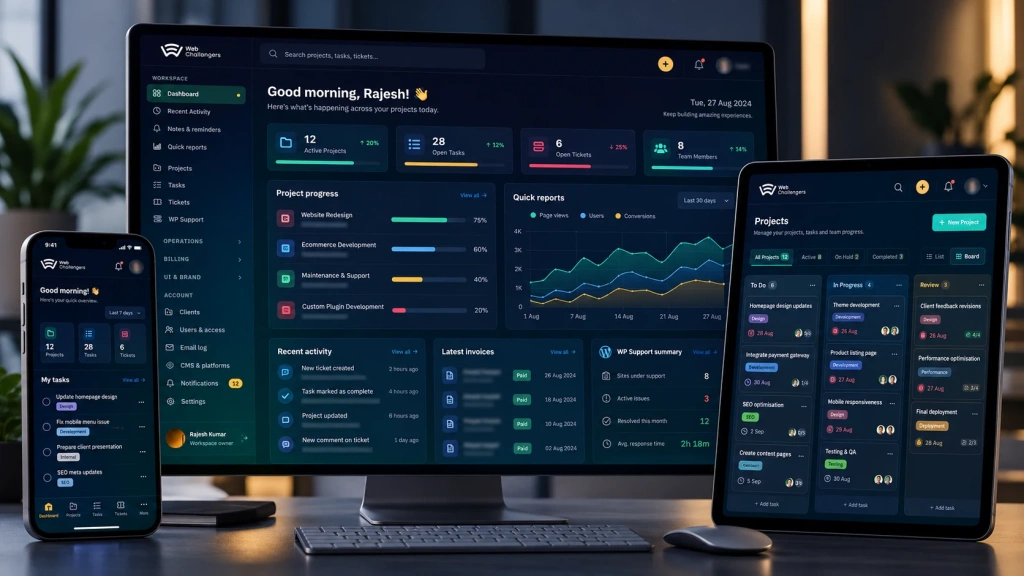
A secure Laravel + Vue platform unifying projects, clients, teams, support, billing and bulk WordPress operations — built to make 400–700+ website estates practical to manage from one place.
View case study↗The aim is to make scope, cost, ownership and long-term support clearer before they become expensive decisions.
Ask something else →Yes. In many projects that is the best time to involve us. We can turn goals, workflows and constraints into a practical scope, identify unknowns and separate launch requirements from later improvements before a large estimate is committed.
We challenge unnecessary complexity, phase work where appropriate, reuse proven patterns, identify integrations early and make assumptions visible. The goal is a smaller amount of better-targeted work, not a cheaper version of the same oversized scope.
Often, but we diagnose before recommending changes. We review performance, caching, database work, media, scheduled jobs, infrastructure and recurring maintenance tasks, then decide whether optimisation, automation or a hosting change is actually justified.
No. We work with existing websites, applications and platforms as well as new builds. That can include technical takeover, stabilisation, modernisation, integrations, performance work, security improvements and ongoing production support.
It helps identify risky assumptions earlier, choose simpler routes when they are sufficient, recognise recurring architecture and support patterns, and resolve trade-offs without adding unnecessary management layers between the requirement and the technical decision.
Bring us the goal, the current system or even an early idea. We can help shape the route, challenge unnecessary complexity and plan a delivery model that works beyond launch.
Discuss your project ↗